
As repair and reverse logistics become more complex, original equipment manufacturers (OEMs) are looking for better ways to coordinate service operations and maintain visibility. At the same time, growing service ecosystems are making day-to-day management more challenging. Products often move between customers, field technicians, depots, logistics providers and third parties, creating more opportunities for delays, unclear ownership and fragmented communication.
A control tower helps technology OEMs improve operations and gain visibility by providing a clearer view of asset status and next steps throughout the product lifecycle. It also brings the moving parts of a service ecosystem into a more coordinated operating model so teams can improve communication and keep service operations moving forward.
Why Are Service Operations Becoming More Challenging to Manage?
Technology products in the field require faster service than ever before. A single asset may move between a customer site, a field technician, a forward stocking location, a repair depot and a recycling or IT asset disposition (ITAD) partner before reaching its final destination.
Expectations for uptime are also on the rise. Customers expect quick turnaround times and accurate updates, even when products span multiple vendors or regions. Internally, OEM teams must balance repair costs, inventory availability, warranty requirements and customer expectations while trying to maintain operational efficiency. In this environment, visibility alone only solves part of the problem. Teams need a way to coordinate activity and determine what should happen next across the service lifecycle.
What Is a Control Tower for Depot Repair and Logistics?
A control tower is a centralized operating model that helps manage service supply chain activity across systems and locations to improve coordination among stakeholders. Rather than relying on disconnected processes or siloed updates, it creates a single view into field and depot repair, returns, logistics and inventory workflows.
For OEMs, this helps answer practical questions that directly affect service outcomes:
-
Where is the asset?
-
Who currently has it?
-
What action is required?
-
What service level agreement (SLA) applies?
-
What should happen next?
That next step may include repair, refurbishment, reuse, return to inventory, parts harvesting, recycling or IT asset disposition (ITAD). A control tower helps coordinate those decisions while maintaining visibility throughout the process.
What Does a Control Tower Actually Manage?
A control tower helps coordinate asset movement, repair activity and inventory decisions across the reverse logistics lifecycle. Depending on the operating model, this can include a variety of activities. Bringing them together in a single view helps OEMs reduce delays and improve consistency across repair and logistics operations.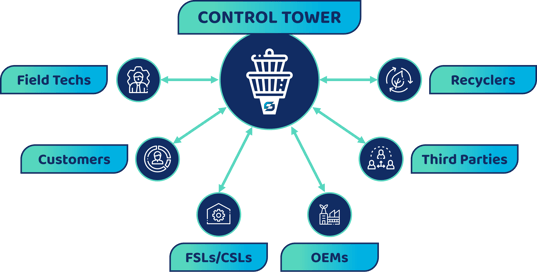
Control tower support services often include:
Inbound activity
-
Field returns
-
Customer returns
-
Hub returns
-
Demo or proof-of-concept (POC) returns
-
Onsite collection
Depot repair and logistics coordination
-
Diagnostics and repair
-
Refurbishment and reconfiguration
-
Engineering change order (ECO) upgrades
-
Secure data erasure
-
Warranty and RMA management
-
Parts harvesting and central stocking
Outbound fulfillment and recovery
-
Advanced exchange support
-
Customer direct shipments
-
Field stocking location replenishment
-
Recycling and ITAD routing
Why Do OEMs Outsource Control Tower Operations?
Outsourcing control tower operations can improve visibility while helping teams respond more quickly when issues arise. Here are a few common benefits of a strong control tower model:
-
Visibility into assets, inventory and consistent SLA performance
-
Better coordination across reverse logistics workflows
-
Faster decisions around repair and disposition
-
Enhanced communication throughout service operations
-
Improved sustainability outcomes
What Should OEMs Look for in a Control Tower Partner?
The right control tower partner can help an OEM create a more connected repair strategy that supports customer expectations and improves operational performance. A strong partner should be able to support the broader repair lifecycle while helping OEMs improve operational efficiency over time.
Key Takeaways for Evaluating a Services Partner:
-
Depot repair and refurbishment expertise
-
Reverse logistics and inventory management support
-
Real-time reporting and asset visibility
-
Global logistics and stocking capabilities
-
Root cause and failure analysis and repair insights
-
Circular economy and sustainability support
-
Flexible service delivery models
-
Secure handling of sensitive intellectual property
-
Program/NPI project management expertise
Improve More Than Repair Turnaround Times
Repair and reverse logistics decisions affect customer experience, sustainability efforts and how much value OEMs recover from their products over time. Strengthening those outcomes requires a more connected repair strategy that improves visibility and coordination across the lifecycle.
Download “The Key Spokes of a Full-Circle Repair Strategy” to learn how OEMs are connecting data, decisions and execution in the reverse logistics process flow to improve repair operations, strengthen logistics coordination and extend product value across the lifecycle.
FAQ: Control Tower Services for OEMs
Q: Why do OEMs need a control tower?
A: A control tower helps OEMs coordinate repair, returns, logistics and inventory activity across multiple stakeholders and locations. It provides visibility into where assets are, what actions are needed and how service operations are performing.
Q: How does a control tower support depot repair?
A: A control tower helps manage repair workflows, warranty activity, parts availability and asset movement throughout the depot process. This improves coordination and helps reduce delays.
Q: How does a control tower improve reverse logistics?
A: It creates better visibility into returns, repairs, refurbishment and recovery decisions while helping teams manage assets more efficiently. This can improve turnaround times and recovery value.
Q: Why should OEMs outsource control tower operations?
A: Outsourcing allows OEMs to scale service operations without managing every aspect internally. It can improve visibility, coordination and operational consistency across regions.
Q: What is the difference between a control tower and basic tracking?
A: Basic tracking shows where an asset is. A control tower provides broader operational visibility, helping OEMs coordinate stakeholders, manage workflows and make informed decisions about next steps.

About the Author
 Bobby Wallace serves as the Vice President of Global Repair Services for Shyft Global Services and TD SYNNEX Services and has been with the company since 2006. In his current role, he focuses on customer growth and scalability, repair service delivery and new business development. He oversees Shyft’s repair operations throughout the globe, including the Netherlands, Poland, Singapore, California and Ohio, which is home to the 586,000 sq. ft. CenterPoint facility, encompassing Shyft’s widest range of end-to-end product lifecycle offerings.